Text Translators
Type a word, a sentence or a whole paragraph and see it written in another system: International Morse code, binary bytes, hexadecimal bytes, Grade 1 Braille, the NATO spelling alphabet, the 24 runes of the Elder Futhark, the ogham strokes of early Irish stones, the Old Persian cuneiform of the Achaemenid inscriptions, the one-consonant signs of Egyptian hieroglyphs, the 22 letters of the Phoenician alphabet, the Baybayin script of the Philippines, Tengwar, the Elvish script from The Lord of the Rings, the handshapes of ASL fingerspelling, or Aurebesh, the alphabet of Star Wars. All of them except Tengwar, ASL fingerspelling and Aurebesh also decode back to text. Everything runs in your browser and nothing you type is sent anywhere.
All text translators
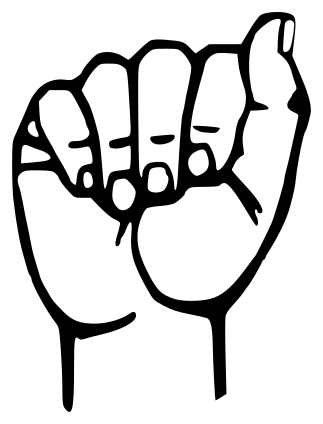
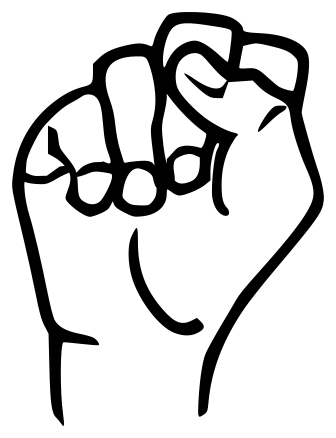
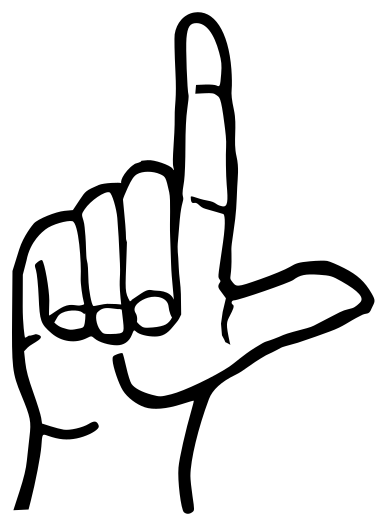
What these translators do
Each tool on this page substitutes characters. It takes the text you type and replaces each letter, or each pair of letters that has a sign of its own, with a character, a code, a word or a picture from the target system. That is what people mean when they search for a "rune translator", a "cuneiform translator", a "hieroglyphics translator" or an "Aurebesh translator": they want their name on a rune stone, a title in the wedges of Darius, a phrase inside a cartouche, a word in the script of a Philippine banknote, a line of Elvish for a tattoo, a name spelled on the hand in ASL, a sign in the lettering of Star Wars. It is not translation in the dictionary sense. The words stay English; only the writing changes. A real translation into Old Norse, Old Irish, Old Persian, Middle Egyptian, Tagalog, Quenya or American Sign Language would need a grammar, a vocabulary and a person who knows the language, and no letter table can do that.
The fourteen systems differ in how well substitution suits them. Morse code, binary, hex, Braille and the NATO alphabet were designed to carry ordinary text, so the conversion is exact and reversible: every letter, digit and common punctuation mark has a code, and the decoder gives back what you typed, with one small exception, that NATO code words carry no capitals and so decode to lowercase. Binary and hex are the same bytes written two ways, eight digits or two per byte. The five ancient scripts and Baybayin were made for other languages, with different sounds and no letters for some English ones, so the tools follow the conventions that museum charts and rune charts use, and decoding them is approximate. Egyptian wrote no vowels at all, and Phoenician wrote none either, so a sign that stands in for u on the way out reads back as u even if you typed o or w; ogham has no k, v, w or y of its own; Old Persian has no e or o; Baybayin writes e and i with one mark and o and u with another. Tengwar is a special case: Tolkien himself wrote English in it, letter by letter, and this tool follows that mode, but there is no decoder. ASL fingerspelling and Aurebesh spell English letter for letter, one as drawings of hands and one in the Star Wars alphabet, and neither has a decoder either.
A few practical notes apply to all of them. Everything except Tengwar, ASL fingerspelling and Aurebesh comes out as ordinary Unicode text, so you can copy the result and paste it anywhere that accepts text, provided the reader has a font for it; recent phones and browsers cover all of these scripts, but older devices may show empty boxes for the rarer ones such as ogham, Old Persian cuneiform and Baybayin. Binary, hex and NATO code words are plain ASCII and display everywhere. Tengwar is not in Unicode, so the Elvish page draws it with a self-hosted font and shows a readable romanization beside the glyphs. ASL fingerspelling and Aurebesh have no Unicode characters at all: the ASL page shows drawings of hands with a copyable gloss such as J-O-H-N, the Aurebesh page draws your text with a self-hosted font and gives copyable letter names, and both save the result as an image. Each translator has a page of its own with a history of the system, an account of exactly what the tool does with each letter, and a plain statement of what it cannot do.
Frequently asked questions
Are these real translators?
They are character converters. Each one rewrites the text you type in a different set of characters, codes, words or pictures, keeping the English spelling. Morse, binary, hex, Braille and the NATO alphabet are exact, because all five were designed to carry ordinary text. Runes, ogham, cuneiform, hieroglyphs, Phoenician, Baybayin and Tengwar write English words in scripts made for other languages, and ASL fingerspelling and Aurebesh spell them letter by letter, but none of these is a translation into another language, American Sign Language included.
Which of these tools can decode back to text?
Eleven of the fourteen: every tool except the Elvish, ASL fingerspelling and Aurebesh translators has a reverse mode. Morse, binary, hex and Braille decode exactly, and NATO decodes exactly apart from case, since code words carry no capitals and come back in lowercase. Runes, ogham, cuneiform, hieroglyphs, Phoenician and Baybayin decode approximately, because several English letters share one sign (c, k and q all become the same rune, for example), so a decoded word can be spelled differently from the original. Those three write only.
Can I copy and paste the results?
Yes, for eleven of the fourteen. Those produce standard Unicode characters that paste into messages, documents and social media like any other text, though Old Persian cuneiform is the script most often missing from a reader's fonts. Tengwar is not part of Unicode, so pasted Elvish glyphs only render where a matching font is installed, and the romanized reading is the safer thing to share. ASL fingerspelling and Aurebesh have no Unicode characters at all, so both are offered as downloadable images, with ASL also giving a copyable gloss and Aurebesh copyable letter names.
Is my text sent to a server?
No. The conversion tables are part of the page, and the translation happens in your browser as you type. Nothing is uploaded, stored or logged, there is no account, and there is no limit on how much text you convert.
How do I type these scripts myself instead of converting?
Most of the scripts have an on-screen keyboard on this site: Morse, Braille, runic, hieroglyphics and Phoenician keyboards in the scripts section, and a Baybayin keyboard among the Southeast Asian layouts, where you click the signs directly. Binary, hex and NATO code words need no special keyboard, ogham and Old Persian cuneiform have none here yet, and Tengwar, ASL fingerspelling and Aurebesh have none. Each translator page links to its keyboard where one exists, and to the matching "your name in" page where one exists.