BSL Fingerspelling Translator
Type a name or a word and see it fingerspelled in the two-handed manual alphabet of British Sign Language, the same alphabet Auslan in Australia and NZSL in New Zealand use. Each letter is a photograph of real hands making it. Copy the gloss, save the hands as an image, or print them as a strip to practise from.
This is fingerspelling: the letters of a name spelled out by hand, which is how a name is introduced. It is not a name sign. Deaf people give each other name signs, usually from a feature or a story, and one cannot be generated from the letters.
How to use the bsl fingerspelling translator
- Type a name or a word. Each letter appears as a photograph of the two hands making it, word by word.
- Read the vowels on the base hand's fingertips: thumb A, index E, middle I, ring O, little finger U.
- Copy the gloss (J-O-H-N), save the hands as a PNG, or press Print strip for a page of large letters to practise from.
- Left-handed? Mirror each letter: your right hand is the base and your left hand points.
Examples
| BSL | 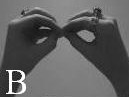 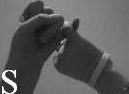 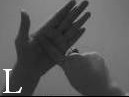 B-S-L |
| Sarah | 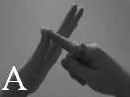 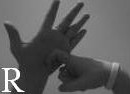 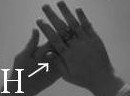 S-A-R-A-H |
| Hello | 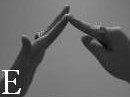 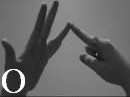 H-E-L-L-O |
About BSL fingerspelling
Fingerspelling is how a sign language borrows a word from the written language around it. British Sign Language has its own vocabulary and grammar, unrelated to English, but names of people and places, brand names and words with no sign are spelled out letter by letter with the hands. It is used most for names: when a deaf person meets someone new, the name is fingerspelled first, and often only once.
The British alphabet is made with two hands, which sets it apart from most of the world. The American alphabet, and the French one it descends from, spell every letter with one hand. In the British alphabet the non-dominant hand is held open as a base and the dominant hand works against it. The five vowels are the five fingertips of the base hand: A is the thumb, E the index finger, I the middle finger, O the ring finger and U the little finger, each touched by the index finger of the other hand. The consonants are shapes made with both hands, several of them echoing the capital letter: D is a curved finger and thumb against a straight finger, W is the fingers of the two hands interlaced.
The same two-handed alphabet crossed with British settlers and teachers of the deaf to Australia and New Zealand, which is why linguists group British, Australian and New Zealand Sign Language as one family, BANZSL. The three languages differ in vocabulary, and some letters have regional variants, but a fingerspelled name in one is readable in the others. British Sign Language was recognised by the UK government as a language in its own right in 2003 and in law by the British Sign Language Act 2022; New Zealand Sign Language became an official language of New Zealand in 2006.
The pictures here are photographs, not drawings: a public-domain chart of the BANZSL alphabet by Neil Evans, cut into one image per letter. Two of the letters move. H is made by brushing the dominant palm across the base palm, and J by tracing a J down the base palm; the arrows on those two photographs show the movement. Left-handed signers mirror every letter, with the right hand as the base. The tool writes what you type as a gloss, the capital letters joined by hyphens that sign language dictionaries and interpreters use, so a fingerspelled John is J-O-H-N.
Fingerspelling is a small part of signing, not a translation into it. Spelling out a sentence letter by letter is slow and is not how deaf people talk; a signed sentence uses signs, space, facial expression and movement. This page is for what fingerspelling is actually for: learning the alphabet, practising your own name, preparing a sign or a card, or spelling a word for which you do not know the sign.
Frequently asked questions
Is this my name sign?
No. This is fingerspelling, the letters of your name spelled out by hand, which is how a name is first introduced. A name sign is different: a single sign deaf people give each other, usually drawn from how the person looks, something they do or a story about them. It is given by someone in the deaf community, and no tool can make one from the letters of a name.
Is BSL fingerspelling the same as Auslan and NZSL?
Yes, the alphabet is shared. British, Australian and New Zealand Sign Language all use this two-handed manual alphabet and are grouped as one family, BANZSL. The languages differ in their signs, and a few letters have regional variants, but a name fingerspelled in one is readable in the others.
Why is the British alphabet two-handed when the American one is one-handed?
They have different histories. American Sign Language descends from French Sign Language, brought to the United States in 1817, and inherited its one-handed alphabet. British signing developed separately, and its two-handed alphabet is recorded in British books from the seventeenth century onward. The two sign languages are unrelated, so a British and an American signer do not share an alphabet.
Why do H and J have arrows?
Because they move. H is a brushing movement of the dominant palm across the base palm, and J traces the shape of a J down the base palm. A still photograph can only show one moment of each, so the chart draws the movement as an arrow.
How do I print my name?
Type it, then press Print strip. A page opens with the letters at print size, one row per word, each letter labelled under its photograph, and your browser's print dialog appears. Save it as a PDF from the same dialog if you want a file rather than paper.
More translators