ASL Fingerspelling Translator
Type a name or a word and see it fingerspelled in the American Sign Language manual alphabet, with a drawing of the handshape for each letter, grouped by word and labeled with the letter it spells. The copyable result is the gloss ASL dictionaries use for a fingerspelled word, capital letters joined by hyphens, so John becomes J-O-H-N, and the hands can be saved as an image. Fingerspelling spells English letter by letter; it is not a translation into ASL signs.
How to use the asl fingerspelling translator
- Type a name, a word or a short phrase. A hand appears for each letter, grouped by word, with the letter printed underneath.
- Look for the arrows on J and Z. Those two letters move, tracing their shape in the air; the other 24 are held still.
- Press Copy gloss to copy the written form, capital letters joined by hyphens, such as J-O-H-N or H-E-L-L-O.
- Press Download as Image to save the hands as a PNG for a handout, a sign or a card. Digits show as numerals, not hands.
Examples
| Hello | 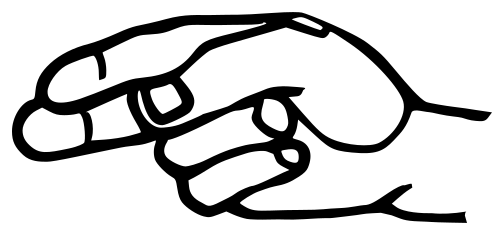 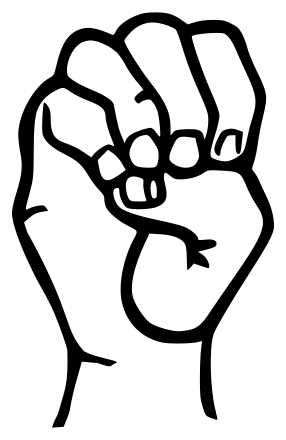 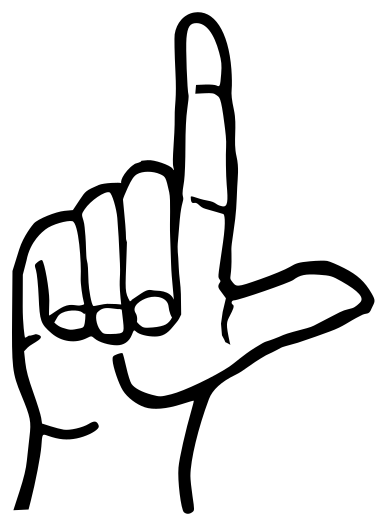 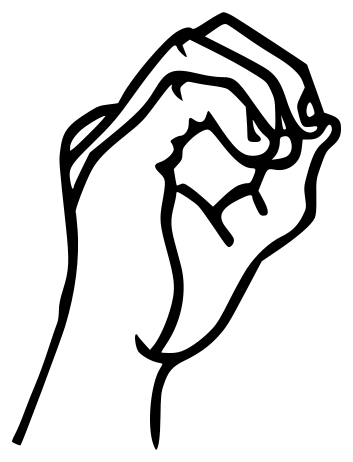 H-E-L-L-O |
| Emma | 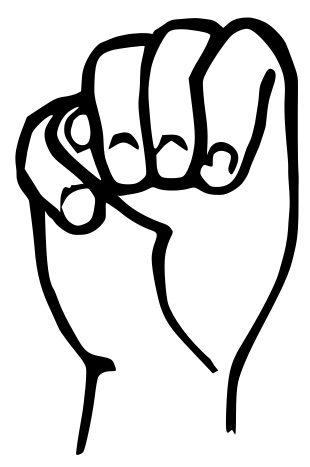 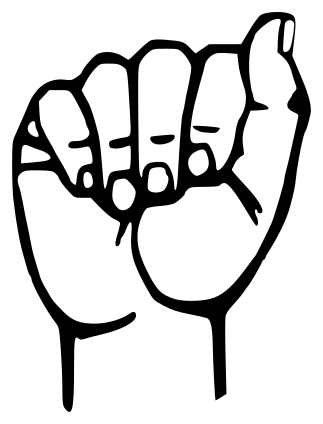 E-M-M-A |
| ASL | 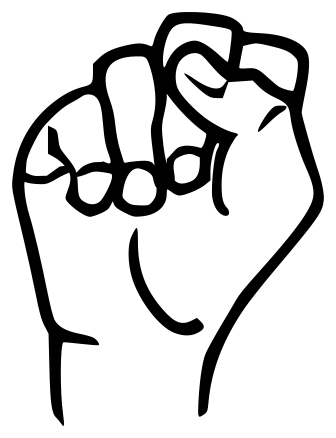 A-S-L |
About ASL fingerspelling
Fingerspelling is the part of American Sign Language that borrows from written English. ASL is a full language, with its own grammar, its own vocabulary and its own word order, used by deaf communities across the United States and much of Canada, and most of what signers say is made of signs, not letters. Fingerspelling fills the gaps: a signer spells out a person's name, a place, a brand name, a technical term or an English word that has no established sign, using one handshape for each of the 26 letters of the English alphabet. A few fingerspelled words are used so often that they have worn down into signs of their own, such as JOB, BUS and OK. So the manual alphabet is a real and useful thing to learn, but it is a small corner of the language. This tool spells what you type; it does not translate English sentences into ASL.
The American manual alphabet descends from the French one. In 1815 Thomas Hopkins Gallaudet, a minister from Hartford, Connecticut, traveled to Europe to learn how deaf children were taught, and in Paris he met Laurent Clerc, a deaf teacher at the national institute for the deaf. Clerc came back with him in 1816, and in 1817 the two founded the American School for the Deaf in Hartford, the oldest permanent school for deaf children in the United States. The French signs Clerc brought, including the French manual alphabet, mixed there with the signing the students already used, and the result became ASL. The American alphabet is one-handed: every letter is made with a single hand. That is not universal. British, Australian and New Zealand Sign Language, a family known as BANZSL, share a two-handed alphabet in which the hands touch to form the letters, so a British signer and an American one fingerspell the same name in completely different ways.
Fingerspelling is usually done with the dominant hand, held near the shoulder with the palm facing the person watching. Each letter is a handshape, not a picture of the letter. A few do look like their letters, such as C, which curves the hand into a C, and L, which holds up the thumb and index finger at a right angle, but most are conventions: A is a closed fist with the thumb at the side, S is a fist with the thumb across the fingers, and E bends the fingertips down to rest on the thumb. Some letters share a handshape and differ only in which way the hand points: K and P use the same fingers, with P pointing down, and so do G and Q, and H and U. Two letters move. J starts from the handshape of I, with the pinky extended, and traces a J in the air, and Z traces a Z with the index finger. The other 24 letters are held still.
This tool takes the text you type and shows each letter as a drawing of its handshape, grouped by word, with the letter printed under each hand. The drawings are the public-domain wpclipart set hosted on Wikimedia Commons in the category ASL letters, and they show each handshape as the viewer sees it on a right-handed signer. J and Z are drawn with an arrow for their motion. Beside the hands the tool writes the gloss, the convention ASL dictionaries and interpreters use to write a fingerspelled word: capital letters joined by hyphens, so John is J-O-H-N and "Hello world" is H-E-L-L-O W-O-R-L-D. The Copy gloss button copies that text, and Download as Image saves a PNG of the hands for a classroom handout, a sign or a card. Accented letters are folded to their base letter, so José is J-O-S-E, and punctuation is dropped.
A few limits follow from drawing letters one at a time. ASL numbers have handshapes of their own, different from the letters, and the image set does not include them, so digits appear in the gloss and as plain numeral tiles rather than as hands. A doubled letter, such as the LL in HELLO, is signed with a small bounce or a slide of the hand to the side, which a still drawing cannot show; the tool simply draws the letter twice. Real fingerspelling is also faster and smoother than a row of pictures suggests. A fluent signer does not hold each letter; the hand moves through the word and each letter blends into its neighbors, so readers learn to recognize the shape of the whole word. There is no decoder, because the tool cannot read a photograph of hands back into text. Used with that in mind, it is a clear chart of your name or word in the American manual alphabet.
Frequently asked questions
Does this translate English into ASL?
No. It fingerspells what you type, letter by letter, which is how signers write names, places, brands and English words that have no sign. ASL itself is a separate language with its own grammar and vocabulary, and a sentence in it is made of signs, not spelled letters. Fingerspelling a whole English sentence would be slow and unnatural for a signer to read. For a name, a word or a short label, though, fingerspelling is exactly what a signer would use.
Why do J and Z have arrows?
Because they are the only two letters of the American manual alphabet that move. J is made with the handshape of I, the pinky extended, and the hand traces a J in the air. Z is made with the index finger, which traces a Z. The other 24 letters are held still, so a single drawing shows them completely, while J and Z need an arrow to show the path of the hand.
What does J-O-H-N mean in the copied text?
It is the gloss, the standard way to write a fingerspelled word in ASL dictionaries, textbooks and interpreting notes. Capital letters joined by hyphens show that each letter is spelled on the hand rather than signed as a word, and words are separated by spaces, so "Hello world" is H-E-L-L-O W-O-R-L-D. Copy gloss gives you that text, which pastes anywhere; for the hands themselves, use Download as Image.
Why are numbers shown as numerals instead of hands?
ASL has its own handshapes for numbers, and they are not the letters: the sign for 6, for example, touches the thumb to the pinky, and several number signs change with how they are used, such as ages and times. The drawings this page uses cover the 26 letters only. Rather than invent hands, the tool shows digits as plain numeral tiles and keeps them in the gloss, so R2 becomes R-2.
Is fingerspelling the same in every sign language?
No. Many sign languages have a manual alphabet of their own. The American one is one-handed and descends from the French alphabet that Laurent Clerc brought to Hartford in 1816, which is why it is still close to French fingerspelling. British, Australian and New Zealand Sign Language share a two-handed alphabet, BANZSL, in which the two hands touch, and it looks nothing like the American one. This page shows the American alphabet only.